What grain-free puppy food means for your puppy
Grain-free puppy food is food in which grains such as wheat, corn, barley and rice have been replaced with other sources of carbohydrate and energy. The purpose is not for the puppy to have fewer carbohydrates, but for them to come from ingredients that many dogs tolerate better. Instead of grains, potato, sweet potato, peas or other vegetables are typically used alongside a high content of meat.
Many choose grain-free because they experience specific problems with the puppy: itching, tear staining, loose stools or a generally sensitive digestion. Grain is not harmful in itself, and most dogs tolerate it fine, but wheat in particular and a few other grains are among the ingredients most often pointed to when a dog reacts to its food. By removing them, it becomes easier to determine whether it is the grain the puppy cannot tolerate, or whether the cause is to be found elsewhere.
This collection brings together The Beginning from Essential Foods, which is a grain-free food developed specifically for puppies and pregnant or nursing bitches. Below we go through when grain-free makes sense, what a puppy food should contain to support growth, and how to choose between the variants for small and large breeds.
Why many choose grain-free food for a puppy
The most important reason is digestion and possible hypersensitivity reactions. A puppy's stomach is still developing, and it reacts more clearly than an adult dog's if the food contains something it has difficulty breaking down. Symptoms such as loose stools, gas, itchy skin or discolored tear staining often lead owners to look at the content of the food, and here grain is one of the first things they cut back on.
It is worth being precise here: true grain allergy in dogs is rarer than many think, and most food reactions are caused by a protein source rather than the grain itself. Grain-free is therefore not a guarantee against all stomach problems. But because wheat and gluten are some of the most common suspects, and because grain in cheap food is sometimes used as filler rather than nutrition, a grain-free food with a high meat content often provides a more meat- and nutrient-dense composition to build growth on.
If your puppy has a genuinely delicate stomach, it may also be relevant to look at food composed to be extra gentle. For that purpose, Essential has a collection under sensitive stomach, which is intended for dogs with sensitive digestion.
Is grain-free puppy food healthier than food with grain?
The answer depends on the individual puppy. For a puppy that reacts to grain or has a sensitive stomach, a grain-free food can clearly result in better stools, less itching and a calmer stomach. For a puppy without problems, grain-free is not in itself healthier than a well-composed food with grain.
What determines the quality is not whether the food is grain-free, but what is used instead. A grain-free food in which the grain has simply been swapped for large amounts of cheap starch is no better than a sensible grain-based food. A grain-free food with a high content of good-quality meat, the right balance of nutrients and easily digestible carbohydrates is, on the other hand, a solid choice for most puppies.
One point that has received attention in recent years is a possible connection between certain grain-free food products with a lot of legumes and a type of heart disease in dogs. The research is not complete, and no direct cause has been established. For you as an owner, this means that you should choose a grain-free food from a producer that works thoughtfully with its ingredient composition, rather than going for the word grain-free alone.
What a puppy food should contain to support growth
A puppy grows quickly, and the food must deliver building materials for muscles, skeleton, coat and immune system all at once. A puppy food therefore places different demands than food for an adult dog.
Protein is central. It supplies the amino acids for building muscles and tissue, and in a good puppy food the majority comes from meat rather than plant protein, because the dog utilizes animal protein better. Fat provides the energy a growing puppy needs, and at the same time contributes omega-3 and omega-6, which support skin, coat and development.
The balance between calcium and phosphorus is particularly important in puppies, because it governs how the skeleton is built up. For large breeds this is critical: too much calcium can cause problems with the rapid bone growth. It therefore matters whether a puppy food is made specifically for puppies, or whether it is just an adult food marketed broadly. If you want to read more in depth about how to assess the content, Essential has a guide on what is good dog food.
Small breed or large breed
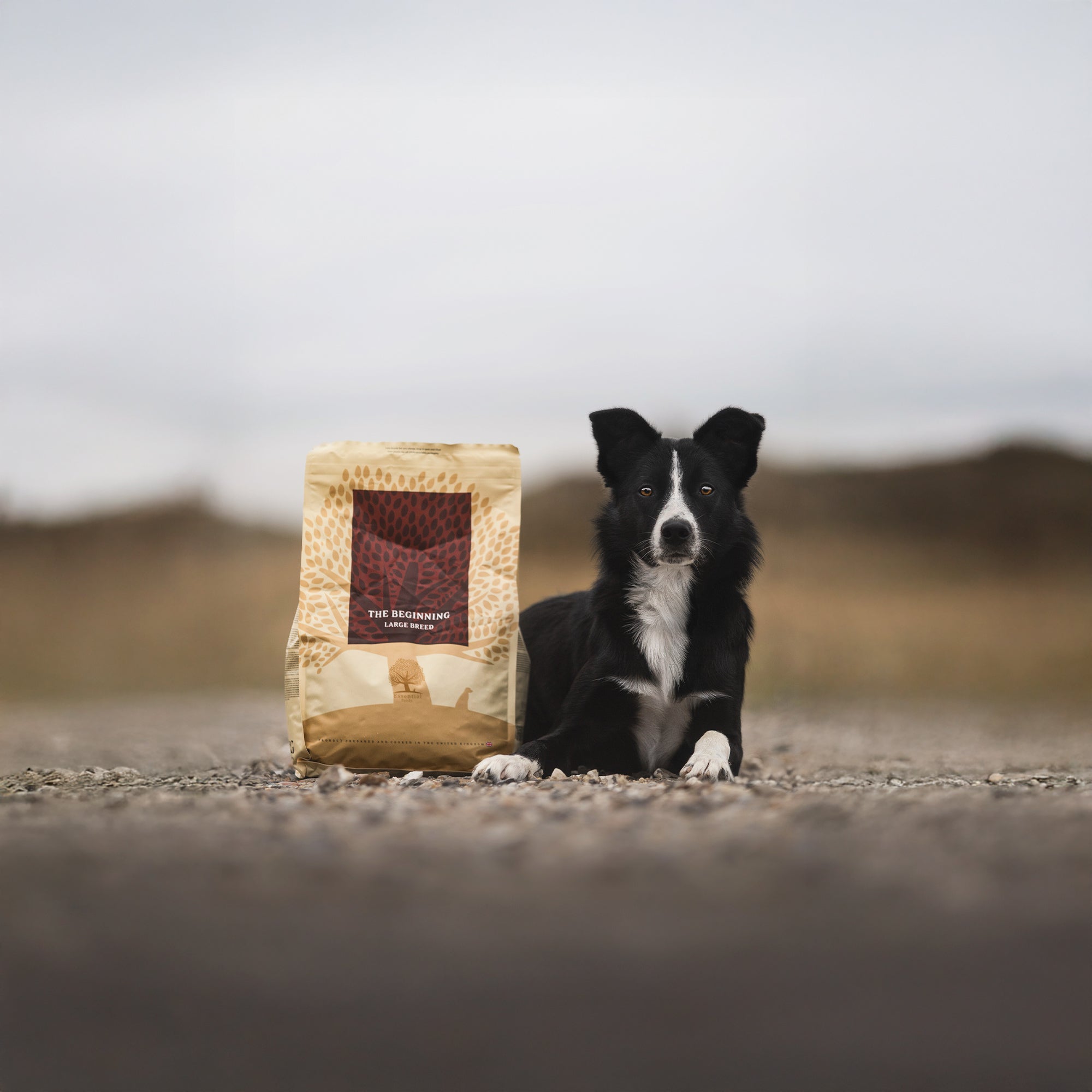
The Beginning comes in two versions, and the choice is about your puppy's expected adult weight, not about its age. The difference is real and matters for both health and practicality.
Small breeds have a fast metabolism and a small mouth. Their food has a smaller kibble size so the puppy can chew it, and an energy density that suits the high consumption. If you choose a small breed, you will find the versions under the Beginning - size - small kibble.
Large breeds grow over a longer period, and here it is crucial that growth does not proceed too fast. Large puppies can be harmed by growing too quickly, and the food for them is composed with that in mind, among other things in the balance of minerals for the skeleton. The versions for large breeds are found under the Beginning - size - large kibble. If you are in doubt about your puppy's adult size, take the breed's standard weight as your starting point or ask the breeder.
Try a small cup before buying a whole bag
A food change should happen gradually, and a new food needs to be to the puppy's taste before it makes sense to invest in a large bag. A sample is therefore a practical way to start.
In the collection you will find both BEGINNING SMALL BREED SAMPLE and BEGINNING LARGE BREED SAMPLE, so you can test the right variant for your puppy's size without committing to a full bag from the start.
When you switch to a new food, mix it in gradually over about a week: start with a small proportion of new food in the old, and increase the proportion day by day. This gives the puppy's stomach time to get used to it and reduces the risk of loose stools along the way, which is extra relevant if you have chosen grain-free precisely because of a sensitive stomach.
How much and how often to feed the puppy
A puppy needs more, smaller meals a day than an adult dog, because the small stomach cannot hold the daily requirement all at once. As a rule of thumb, the daily ration is typically divided over three to four meals in very small puppies and tapered down toward two meals as the puppy gets older.
The amount depends on the puppy's current weight, expected adult weight and activity level, not on its age alone. On the bag you will find a feeding guide with grams per day based on precisely these figures, and it is your best starting point. Then adjust according to how the puppy looks and thrives: you should be able to feel the ribs without being able to see them clearly.
Treats count toward the daily amount, so remember to factor them in when you train. If you want to use rewards suited to a puppy, you can look at puppy treats, and a review of what is suitable can be found in the article what puppies can have as treats.
Wet food as a supplement to the grain-free dry food
Some puppies eat more willingly when the dry food is accompanied by something wet and fragrant, and a pâté can make the bowl more appealing to a fussy or slightly delicate puppy. It can also be a help during the transition, while the stomach gets used to a new food.
Essential has a puppy pate intended for puppies, which can be used on its own or mixed into the dry food. Keep an eye on the total amount so the meals do not become too large when you combine wet and dry, and correspondingly reduce the dry food when you add pâté.
If you want everything gathered from the start, there is a puppy starter box that brings together several of the parts for the first weeks with a new puppy in the home.